Ishihara Test Online
Take a free Ishihara-style colour blindness test below, then read what the real Ishihara test is, how it is done and how it is scored.
- 20 plates
- About 3 minutes
- Type and severity
Finding the plates hard? Try the easy test with big single-digit numbers.
Before you start
- Turn screen brightness up and switch off night mode, blue-light filters and colour-inverting settings.
- Hold your phone or sit at a normal reading distance, in daylight or a well-lit room.
- Give each plate 3 to 5 seconds. Your first impression is the answer that counts.
- If you wear glasses for reading, keep them on.
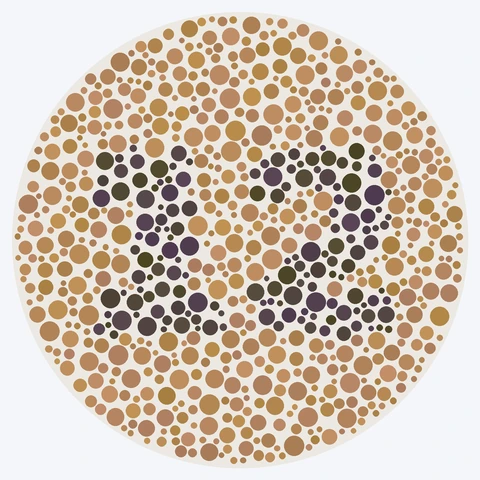
What is the Ishihara test?
The Ishihara test is a colour vision test that uses plates of coloured dots with a number hidden inside. People with typical colour vision read the number; people with red-green colour blindness read a different number or none at all.
It was created by the Japanese ophthalmologist Shinobu Ishihara and first published in 1917. It is still the most widely used screening test for red-green colour vision deficiency in clinics, schools and job medicals.
How does the Ishihara test work?
Each plate is a circle of dots in different sizes and shades. The dots that form the number and the dots around it are chosen so they differ only in hue along a red-green confusion line. Brightness varies at random, so the number can't be found by lightness alone.
If your red (L) or green (M) cones work differently, those hues look alike and the number fades into the background. Some plates are designed the other way round, so people with a deficiency see a number that others miss.
How many plates does the Ishihara test have?
The full Ishihara test has 38 plates. Shorter editions use 24 or 14 plates and are common for quick screening.
| Edition | Plates | Typical use |
|---|---|---|
| Full edition | 38 | Eye clinics, detailed screening and classification |
| Standard edition | 24 | Schools, occupational health, routine screening |
| Concise edition | 14 | Quick screening |
How the Ishihara test is done
- The plates are viewed in good daylight or a daylight lamp, at about 75 cm (30 inches).
- The book is held at a right angle to your line of sight.
- You say the number on each plate, usually within about 3 seconds.
- Both eyes are usually tested together; each eye is tested separately when an eye condition is suspected.
- The examiner counts how many plates you read correctly and notes any plates read the colour-deficient way.
How the Ishihara test is scored
In the 38-plate edition, the first 21 plates are used for the pass or fail decision. Reading 17 or more of them correctly is normal colour vision; 13 or fewer points to a red-green deficiency. The answer key page has the full scoring rules and the answers to our own plates.
Is this the real Ishihara test?
No. The Ishihara plates are a printed, copyrighted test. Our test uses 20 original plates built on the same principle and calibrated for screens. It also adds blue-yellow plates, which the Ishihara test doesn't have, and estimates your type and severity.
An online test is a screening aid. Official tests for jobs and licences are done in person with the printed plates.
Ishihara test questions
Can the Ishihara test be done online?
You can take an Ishihara-style screening online, like the one on this page. The printed Ishihara book is designed for daylight on paper, so a screen version is a guide, not an official result.
How long does the Ishihara test take?
About 2 to 5 minutes. Each plate gets roughly 3 seconds, and the full 38-plate edition is rarely shown in full for a simple screening.
Is the Ishihara test hard?
Not for people with typical colour vision: the numbers are clear. Some plates are deliberately faint, so a single miss is common and is not a fail on its own.
Is the Ishihara test monocular or binocular?
Screening is usually binocular, with both eyes open. Each eye is tested separately when an acquired problem such as optic nerve disease is suspected, because those affect one eye more than the other.
Should I wear glasses for the Ishihara test?
Yes, wear your normal reading glasses or contact lenses. Tinted or colour-correcting lenses are not allowed in official tests.
Can you pass the Ishihara test if you are colour blind?
The test is designed to catch red-green colour blindness, and memorised answers are spotted because examiners change the order and use other tests. If a job requires normal colour vision, ask which follow-up tests it accepts instead.
See the answers and what your score means.
Ishihara test answers