Color Blind Test
A free online colour vision test with 20 dot plates. It works out your likely type of colour blindness and estimates its severity.
- 20 plates
- About 3 minutes
- Type and severity
Finding the plates hard? Try the easy test with big single-digit numbers.
Before you start
- Turn screen brightness up and switch off night mode, blue-light filters and colour-inverting settings.
- Hold your phone or sit at a normal reading distance, in daylight or a well-lit room.
- Give each plate 3 to 5 seconds. Your first impression is the answer that counts.
- If you wear glasses for reading, keep them on.
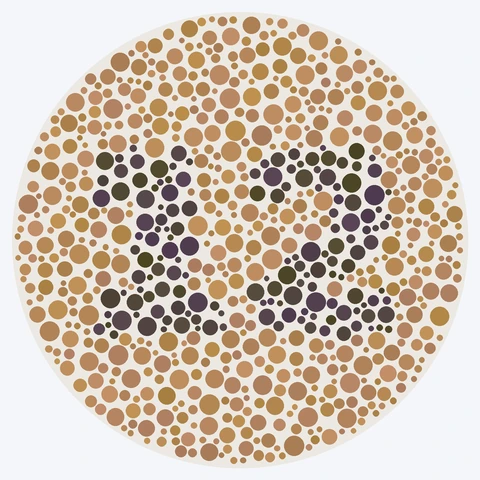
How this colour blindness test works
Each plate hides a number in a field of coloured dots. The colours of the number and the background differ only along a line of colours that a particular type of colour vision deficiency cannot separate. People with typical colour vision read the number; someone with that deficiency sees the number fade or vanish.
The plates get fainter as you go. Some are invisible to protan (red-weak) vision, some to deutan (green-weak) vision, and some to tritan (blue-yellow) vision. Two-digit plates show one digit to each red-green type, which is how the test tells them apart.
When you finish, the calculator compares the pattern of plates you read and missed with how each type and severity would see them, and reports the best match.
Who should take a colour vision test
Anyone who confuses colours that others tell apart, parents curious about a child who mixes up crayons, and people preparing for a job or licence that asks for normal colour vision. Red-green colour blindness is inherited and usually present from birth, so many people only find out as adults.
Read how the test estimates type and severity
Types of colour blindness at a glance
Most colour vision deficiencies are red-green and inherited. Blue-yellow deficiency is rare, and total colour blindness is very rare.
| Type | Cone affected | How common |
|---|---|---|
| Deuteranomaly | Green (M) cone shifted | About 5% of men |
| Protanomaly | Red (L) cone shifted | About 1% of men |
| Deuteranopia | Green (M) cone missing | About 1% of men |
| Protanopia | Red (L) cone missing | About 1% of men |
| Tritan types | Blue (S) cone | About 1 in 10,000 people |
| Achromatopsia | No working cones | About 1 in 30,000 people |
Learn more about each type of colour blindness
Frequently asked questions
Is this color blind test accurate?
It reliably picks up moderate and strong red-green deficiencies and most dichromacy on a normal screen. Very mild cases can pass, and screen settings can affect the result. Treat it as a screening, then confirm with an optometrist.
What does the severity percentage mean?
It is where your answers sit on a simulation scale. 100% means one cone type behaves as if missing (for example protanopia). Lower values mean the cone is present but its sensitivity is shifted. It does not mean you miss that share of all colours.
Is this the Ishihara test?
No. The Ishihara test is a printed book of plates used by eye-care professionals. This test uses original plates built on the same idea of hidden numbers in coloured dots, designed and calibrated for screens.
Can I take the colour blind test on my phone?
Yes. The plates scale to your screen. Turn off night mode and blue-light filters first, and turn the brightness up.
Why is colour blindness more common in men?
The genes for the red and green cone pigments are on the X chromosome. Men have one X chromosome, so a single altered copy causes the deficiency. Around 8% of men and 0.5% of women of Northern European ancestry have red-green colour blindness.
Can colour blindness be cured?
Inherited colour blindness has no cure. Tinted filter glasses can increase contrast between some colours for some people, but they do not restore normal colour vision and won't help you pass an official test.